
It’s campaign season. CEOs should be taking notes.
The lesson isn’t about politics. It’s about keeping a strategy alive long after the announcement.
We are deep in midterm season, and we’re all being bombarded with campaign messages. Whatever you think about politics, campaigns offer an important framework for CEOs and their comms teams to adopt.
Every political campaign understands something many companies seem determined to forget:
Saying something once is usually the same as not saying it at all.
A candidate doesn’t release a platform, mention it at the kickoff rally, and assume voters will remember it months later. The campaign returns to a small number of priorities again and again. It translates them for different constituencies. It equips surrogates to carry them. It reacts to events without abandoning the central argument. And it keeps offering evidence (good evidence in the best cases, selective evidence in the worst) to show that its candidate and agenda deserve support.
Companies do something very different.
The leadership team spends months developing a strategy. The CEO unveils it at a town hall or leadership meeting. Employees receive a presentation, a follow-up email and perhaps a page on the intranet. Then the organization moves on to the next announcement.
Later, executives are surprised to find that employees cannot name the strategic priorities, managers interpret them differently, and functions keep making decisions as if the new strategy didn’t exist.
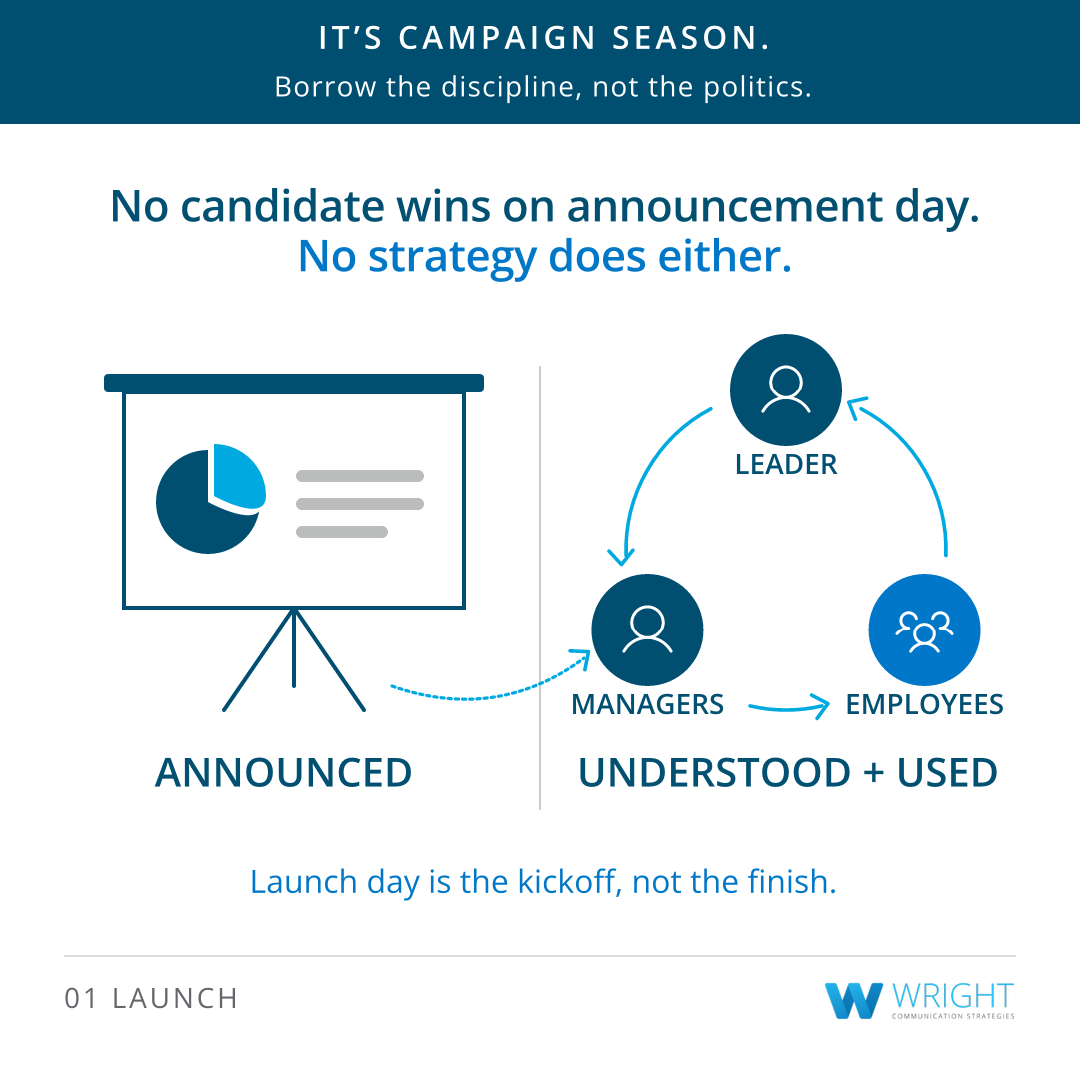
The CEO’s job is not merely to announce the strategy. It is to campaign for it clearly, credibly and continuously until people can recognize it, explain it and use it.
One public-company CEO who once worked on a political campaign called running a public company “an everyday election,” with investors who “vote with their dollars every day” and employees “voting with their feet.”
Let's examine the people, processes, systems and tools to communicate strategy the way disciplined candidates run campaigns.
It’s campaign season. CEOs should be taking notes.
Announcing a strategy is not the same as being understood
The case for campaigning for the strategy
Borrow the discipline, not the spin
Repeat the strategy. Refresh the proof.
Every proof point needs a status
The campaign headquarters: one executive editorial calendar
Companies already work this way
What the evidence shows, and what it does not
Announcing a strategy is not the same as being understood
The gap is measurable. Researchers writing in MIT Sloan Management Review found that fewer than a third of the executives and middle managers responsible for executing strategy could list three of their company’s strategic priorities. At one large technology company, nearly all the senior leaders surveyed said they had a clear understanding of the company’s priorities. Yet only a quarter of the managers surveyed could list three of its five strategic priorities, and a third of the leaders charged with carrying out the strategy could not list even one.
That is the gap between believing a strategy is clear and being able to name it. People absorb a clear message when they hear it repeatedly, through different channels, from people they trust.
Leaders often miss the gap. In the U.K.’s IC Index 2026, a large survey of workers from the Institute of Internal Communication, nearly nine in ten senior leaders agreed that their employer had been clear on its strategy. Among employees without management roles, just over half agreed. The report’s headline for that finding: “Leaders are overestimating how well the strategy has been communicated.” These are people’s own answers, not a test of what they can recall, but they point in the same direction as the MIT Sloan research.
Who delivers the message matters, too. The same IC Index 2026 found that “hearing from the CEO or most senior leader is the method of communication that correlates with higher levels of trust and people feeling that the reasons behind changes are clearly communicated.”
The case for campaigning for the strategy
That CEO, who runs FiscalNote, made the case in a sentence. He described a need for “a maniacal focus on a North Star or a series of North Stars,” and added, “I have to communicate that consistently to every single stakeholder.”
Consistency moves work. Harvard Business School Working Knowledge reported that “managers who are deliberately redundant as communicators move their projects forward more quickly and smoothly than those who are not.” It was a small study of project managers, and it found no difference on deadlines or budgets.
The job takes a steady rhythm of three things: the strategy, the proof that it is working, and a clear request for what people should do.
None of this means producing more content. A campaign for the strategy is measured by what people understand and do, not by how much you sent.
THE CEO’S JOB
The CEO’s job is not merely to announce the strategy. It is to campaign for it until people can recognize it, explain it and use it.
Borrow the discipline, not the spin
The comparison needs a firm line. Employees are not an audience to win over with clever framing. A hard question at a town hall isn’t an attack to neutralize. A number that complicates the story isn’t opposition research to bury.
Four habits, common in campaigns and companies alike, stay out:
Manipulation: picking the anecdotes that hide the contrary evidence.
Propaganda: repeating a claim because repetition works, whether or not it is true.
Us versus them: treating questions or dissent as disloyalty.
Spin: declaring victory early and presenting activities as outcomes.
The danger is real because repetition works on weak claims, too. A 2026 meta-analysis in Nature Communications found that repeating a statement makes it seem truer, an effect the authors call “small but robust,” and that it works on false statements as well as true ones. A review in Current Opinion in Psychology notes, “Repetition even increases belief in claims that are implausible or that contradict prior knowledge.”
That is a reason to care, not to stay silent. A CEO who repeats a claim the company cannot support is spending trust, not building it. Every repetition has to carry evidence.
The CEO does not need to become a candidate, either. The campaign needs the strategy message and how it is delivered. An Academy of Management Journal study found that “highly-regarded CEOs enhance their firm’s reputations, sometimes substantially, and CEOs who receive negative press coverage damage their firms’ reputations.” But, it added, “CEO prominence alone was not associated with higher firm reputation.” Visibility is not the point. Substance is.
The habits worth keeping are the disciplined ones: a short platform, message discipline, translation for each audience, trusted messengers, a response to events, listening, proof, and a rhythm that continues after launch day.
Repetition is not a slogan
Repetition has a bad name because so much of it is empty. A slogan repeats the words without explaining the decisions and trade-offs behind them. People learn to recite it and ignore it.
Disciplined repetition is different. It keeps the priorities the same and keeps explaining them. The communications chief of General Mills, who once worked as a political spokesman, said in an interview that “most of the time when people think of a campaign discipline, they think, ‘I’m gonna say the same thing over and over again until not only is my audience sick of hearing it and I’m sick of saying it.’ Sure, that’s one aspect.” Then he added, “The other aspect of campaign discipline is choosing what not to say.” His rule: “You have to pick and choose the fewer, bigger, better.”
So start with a short platform. Three or four strategic priorities are enough. More than that, and nobody can repeat them.
Then keep saying them long after they feel familiar to you. Leaders live with the strategy for months before the first employee sees a slide, so they tire of it long before the company hears it. The CEO of The Honest Company told a Harvard Business Review audience in July 2026, “you might have to say something three, four, five, seven times and you know you’ve said it enough when it’s starting to come back to you.” She was talking about analysts and investors as well as her own employees.
Hearing it come back is a useful test. A strategy has stuck when people can answer, in their own words:
What few outcomes is the company pursuing?
Why were those chosen over the alternatives?
What will the company do differently, and what will it stop doing?
What does this mean for my team’s work this quarter?
What recent evidence says it is working, or not yet?
The same MIT Sloan research found that just over half of the leadership team could list the company’s main priorities, and that agreement on them fell to about one in five among the senior executives who report to them. Of all the survey’s questions, the one that best predicted alignment was how consistently managers at every level explained their team’s priorities, both for their own unit and for the whole company.
A strategy message needs two things at once: consistency across levels, so every leader describes the same choices, and local meaning, so each explains what those choices mean for a function, a region or a shift. Consistency alone sounds like a script. Local meaning alone sounds like five different strategies.
Repeat the strategy. Refresh the proof.
The priorities stay fixed long enough to be remembered, while the evidence changes every week.
Most leadership communication manages one half. Some companies keep renaming the strategy, and employees have to work out each time whether it is a new priority or a new slide. Others repeat the same three words long after they stopped carrying information, until people can recite the pillars and cannot name one thing the company has done differently.
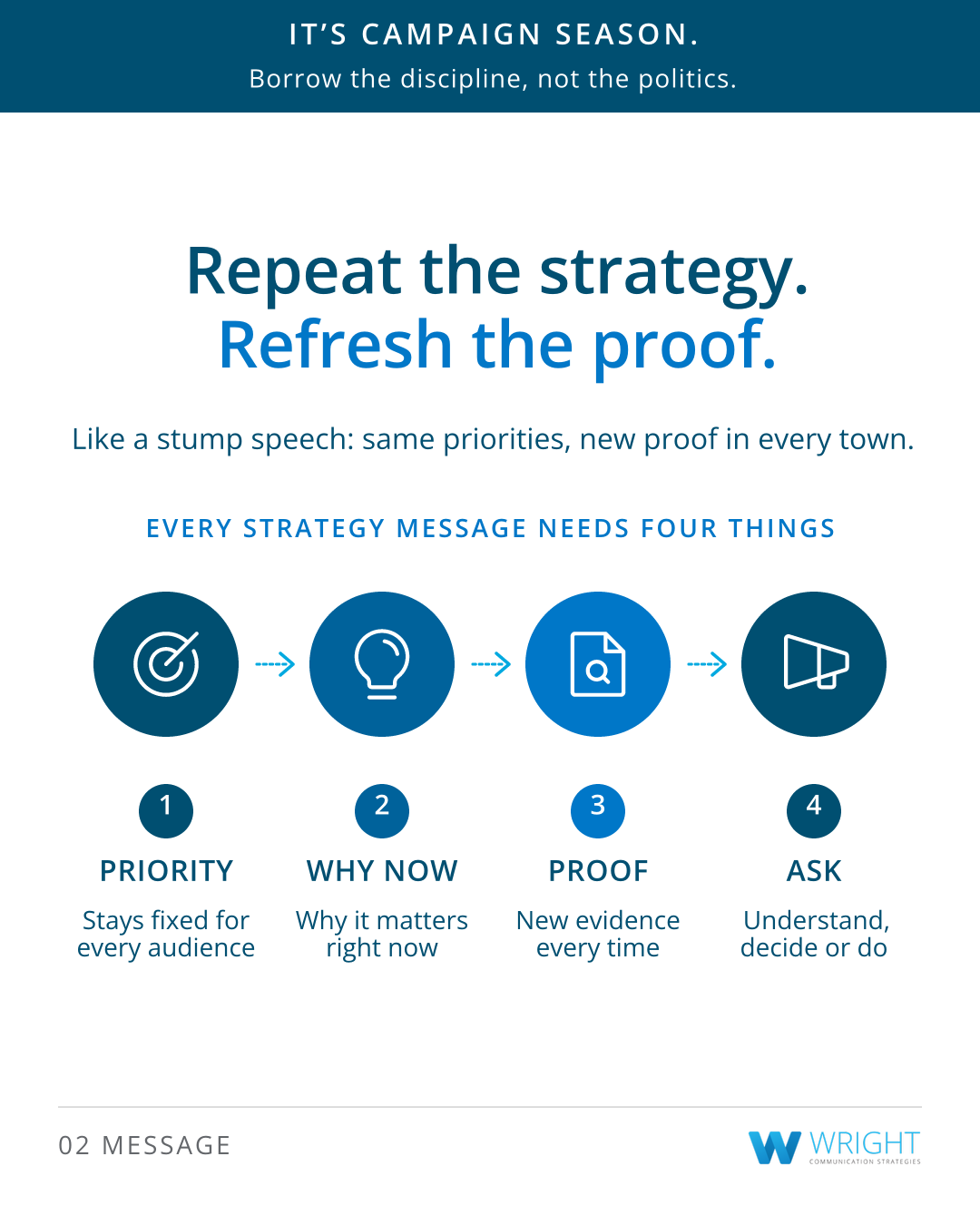
The fix is to hold the spine steady and keep the proof fresh. Every message carries four parts, so each repetition carries something new:
The priority, which stays the same every time.
Why it matters now.
The proof: what happened recently that shows progress, or shows where the company is behind.
The ask: what this audience should understand, decide or do.
Say one priority is faster delivery. This week’s note from a plant manager might name it, explain why it matters now (a large customer decides on its renewal next month), provide proof (on-time shipments are up since spring), and ask the team for one thing (flag a delay a day sooner). Next week the priority is the same. The proof is new.
Companies have more proof than they use: operating results, customer wins, employee stories and financial progress. For customer retention, fresh proof might be a renewal saved because two departments worked together, or a churn number that is still too high. For operating discipline, it might be an approval step removed, or a missed target and what the company is doing about it.
The honest version includes the shortfalls. A CEO who only reports wins risks teaching people to discount every report. The point is not to manufacture a weekly success story. It is to make the strategy visible in the company’s choices and their consequences.
THE MESSAGE FORMULA
Every strategy message needs four things: 1. The priority. 2. Why it matters now. 3. Current proof. 4. What this audience should understand, decide or do.
Every proof point needs a status
A proof point is not any good news the communications team can find. It supports a specific claim in the strategy and should indicate how far along that claim is.
Keep a proof-point ledger, one row per piece of evidence, with these fields:
Field | What it records |
|---|---|
Priority | Which part of the strategy the evidence supports |
Claim | What leadership says is changing |
Evidence | The result, decision, customer signal or milestone |
Status | Commitment, activity, early signal or confirmed outcome |
Source | The system, team or executive who can verify it |
Audience | Who should hear it, and why they would care |
Limit | What the evidence does not yet show |
Use by | When it goes stale and needs updating |
Owner | Who checks it and follows up |
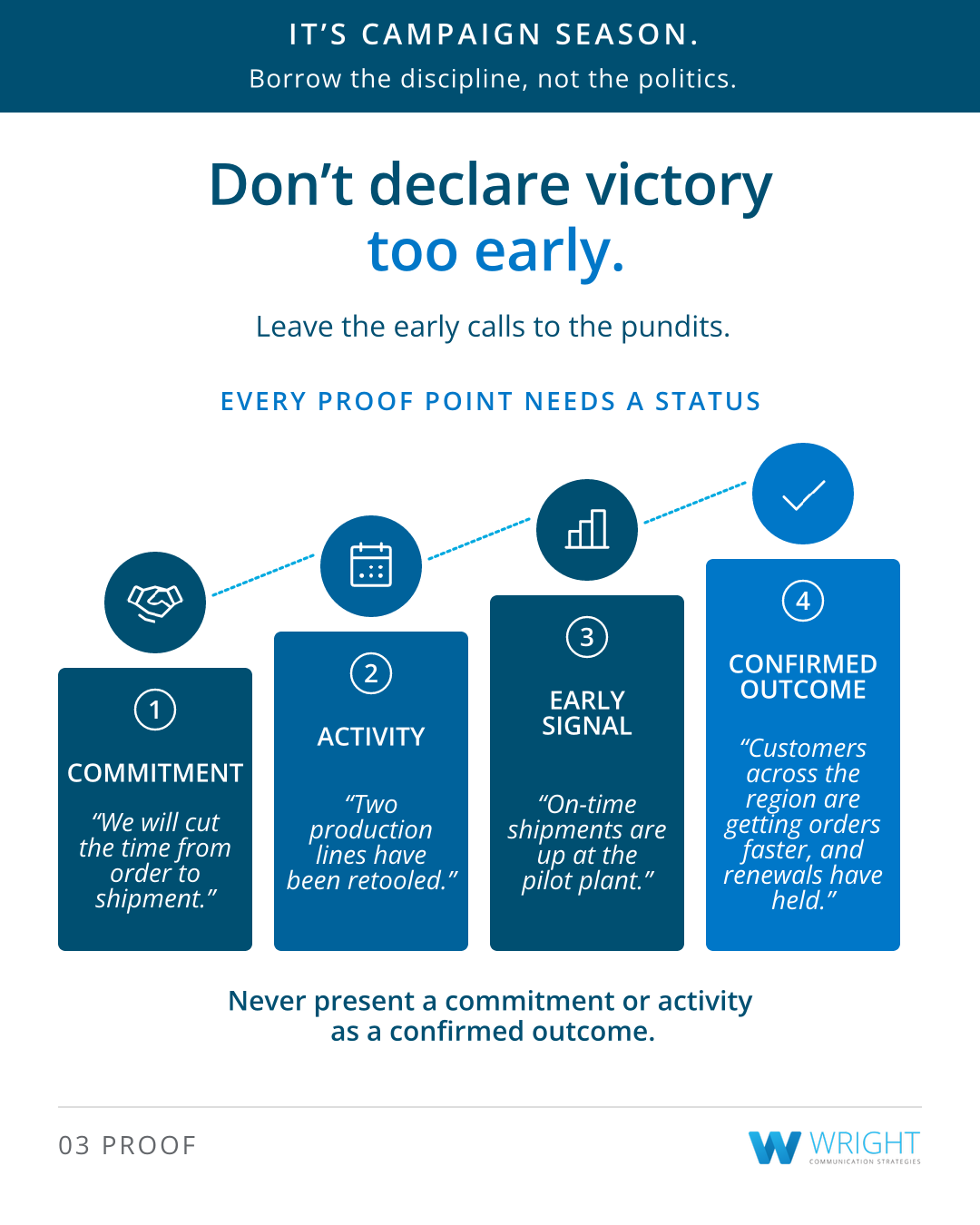
The status field does most of the work. Take the faster-delivery priority again:
Commitment: we will cut the time from order to shipment.
Activity: two production lines have been retooled.
Early signal: on-time shipments are up at the pilot plant.
Confirmed outcome: customers across the region are getting orders faster, and renewals have held.
Label each item so you can tell a promise from a result, and when an early signal becomes an outcome, that is news worth repeating.
CREDIBILITY CHECK
Never present a commitment or activity as a confirmed outcome. People notice, and credibility pays the price.
Who carries the campaign
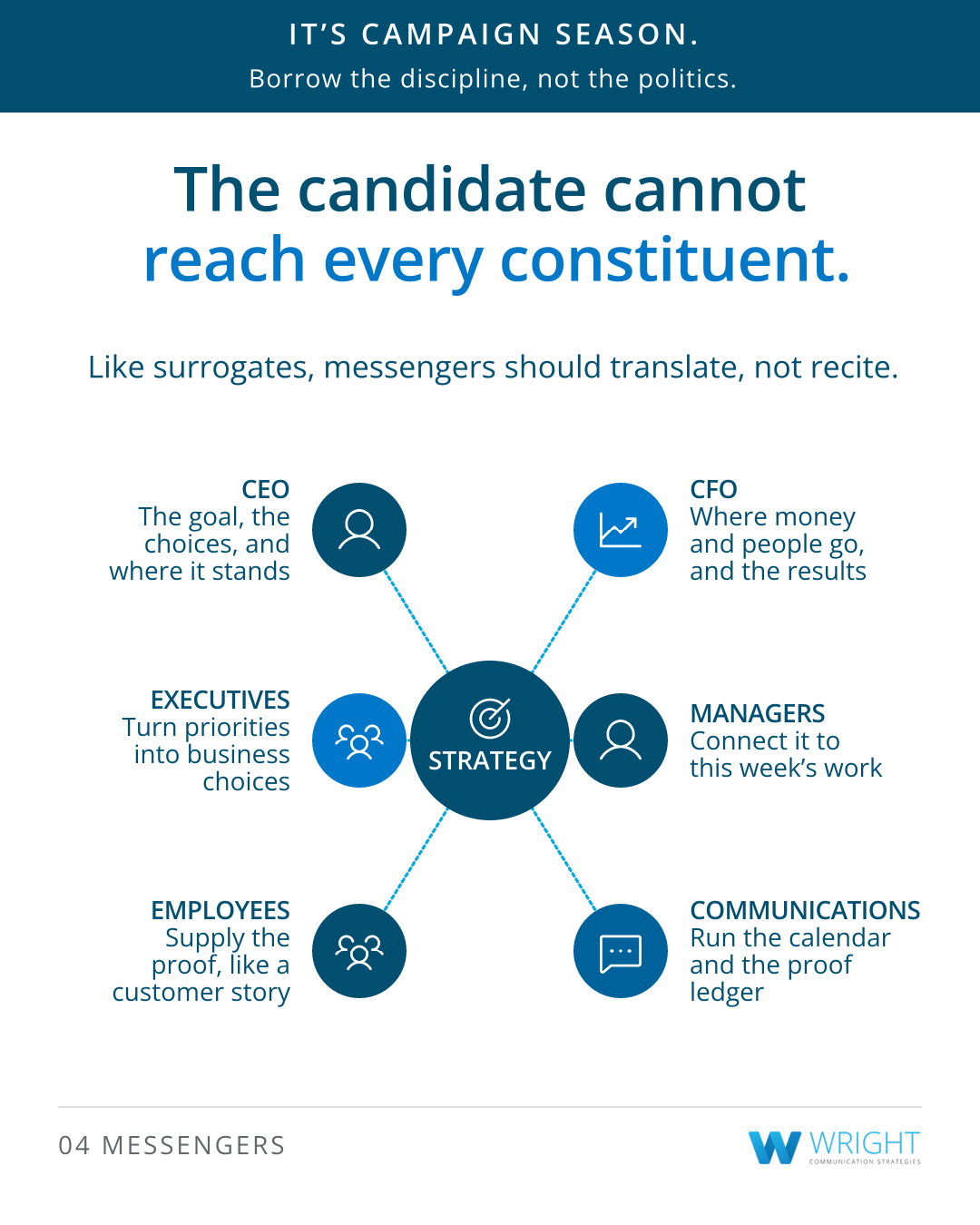
No campaign rests on the candidate’s voice alone. Surrogates carry the same few priorities to people the candidate will never meet. A company works the same way, with one difference: its surrogates should not recite approved lines. They should translate.
The CEO owns the enterprise case: what the company is trying to achieve, the choices behind it, and where it stands. The CEO does not need to deliver every anecdote.
The CFO connects the strategy to where money and people are going, and to the results that will show it is working.
Other executives turn the priorities into customer, market and operating choices for their part of the business. The head of people explains what roles, skills and incentives will change.
Managers connect the strategy to this week’s work. Gallup calls manager conversations the “last mile” of effective change communication. If managers cannot explain the strategy in their own words, it stops at their door.
Employees supply the proof: the customer story, the fixed process, the thing that still does not work. Their evidence is often more credible than another word from the CEO.
The communications team runs the system: the calendar, the proof ledger, the briefings, the reviews and the measures.
The consulting firm Gagen MacDonald, writing for the Institute for Public Relations, recalled a CEO who said, “A story isn’t a story until more than one person can tell it.” His leaders, it wrote, had to answer questions such as, “How does this change my job?”
Equipping the messengers takes more than talking points. Give them the reason behind each choice, examples that fit their teams, the likely questions, what is still undecided, and where to send a question they cannot answer. Then give them a way to send back what they hear.
Messengers can reach outside the company, too. IMA Financial Group, as PR Daily describes it, “sends relevant thought leadership directly to clients and prospects, often through the salespeople who already have relationships with them.” Its “industry cohorts made up of employees from different regions” regularly share what they are seeing.
One priority, seven audiences
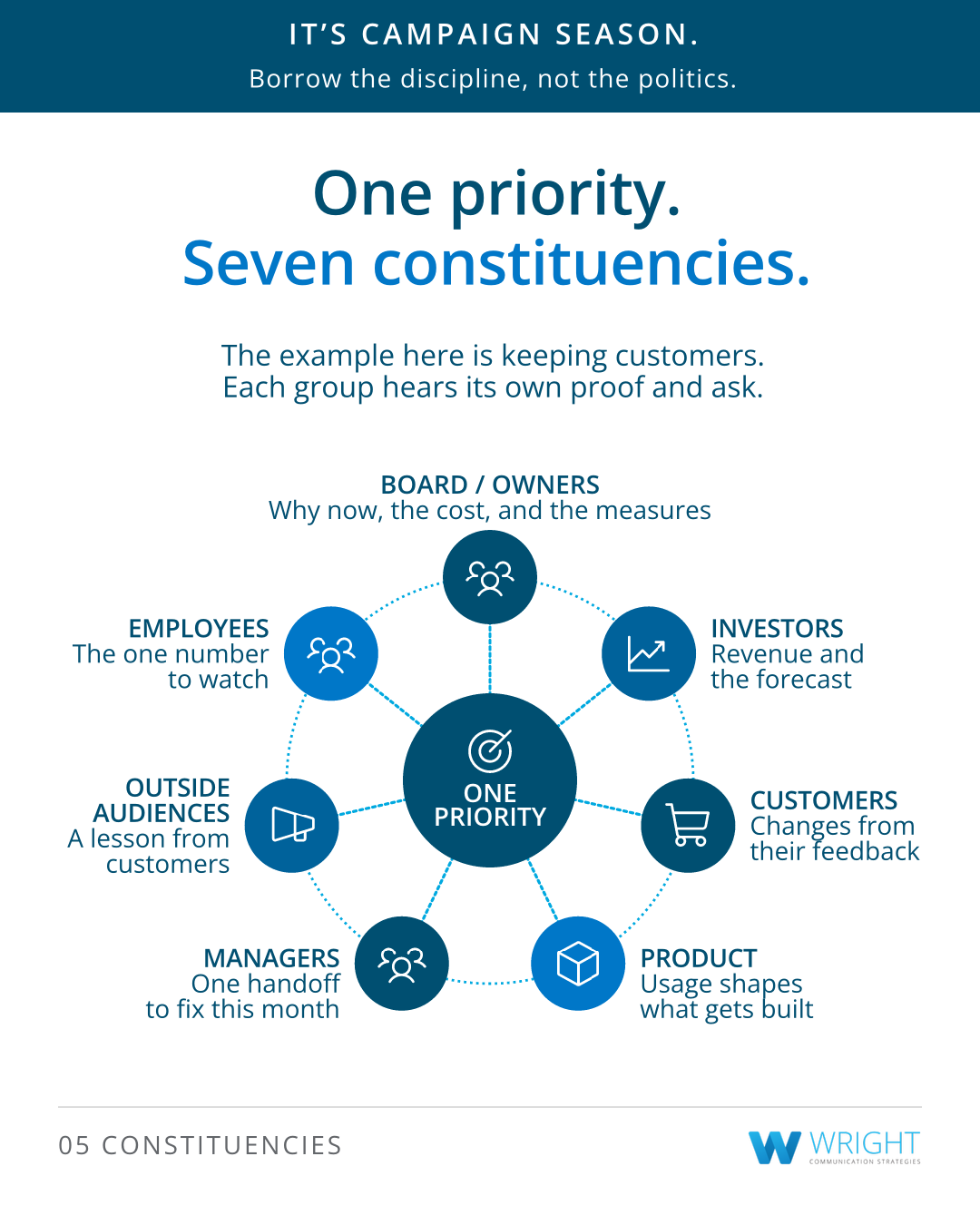
A shared narrative should not produce identical messages. Here is one priority, improving customer retention, and how each audience might hear it.
The CEO, to the board or the owners, sets out why retention is now the priority, what the company will spend and stop doing to fix it, and which measures the board should hold management to.
The CEO, at the employee town hall, explains why keeping customers is now the company’s most important way to grow, what the company is changing across departments, and the one number everyone should watch.
The CFO, to investors, explains how retention shows up in recurring revenue, the cost of winning new customers and the reliability of the forecast.
A product leader, to the teams that build, shows how customer usage is now shaping what gets built next.
A manager, in the weekly team meeting, names one handoff the team will fix this month, and asks: Where do we create friction for customers? Which of our numbers warns us first? What can we change now without waiting for a program?
Account teams, to customers, show what the company has changed because of what customers told it, and what comes next.
Outside audiences, in the CEO’s post or a byline, hear a lesson from customers that illustrates the company’s point of view, without disclosing results the company has not released.
The priority never changes. The detail, the evidence and the ask change with the audience. Someone has to see all seven messages at once, the way a campaign’s headquarters sees every stop on the schedule.
The campaign headquarters: one executive editorial calendar
The next sections are the working parts, for your communications lead. The CEO’s part is the quarterly review.
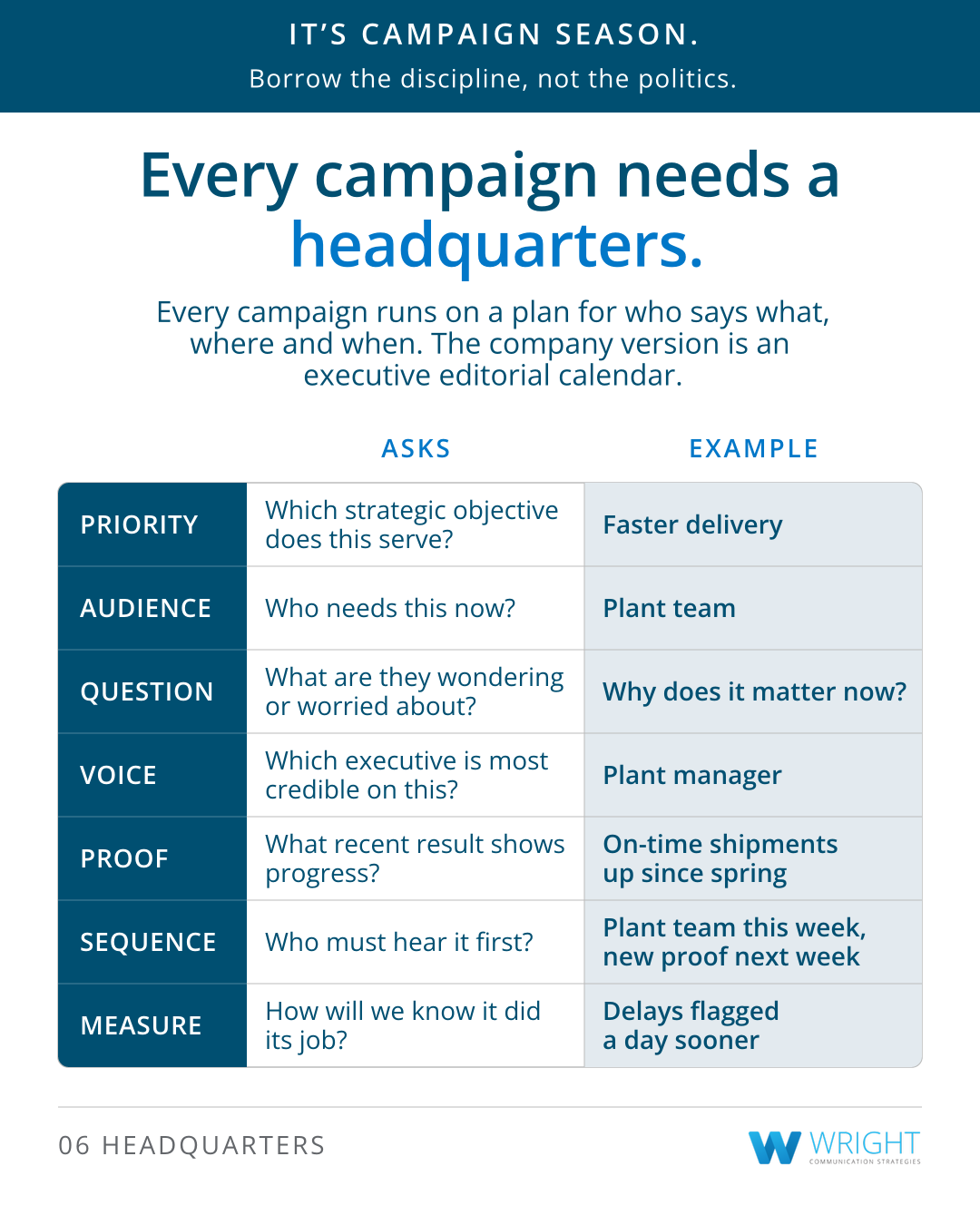
Every campaign runs on a plan for who says what, where and when. The company version is an executive editorial calendar.
An executive editorial calendar is a shared planning record for every communication a senior leader delivers, signs or appears in, inside and outside the company. It is broader than a schedule of social posts and narrower than the CEO’s appointment calendar.
THE OPERATING SYSTEM
An executive editorial calendar is not a social-media schedule. It is the operating system for who says what, to whom, when, with what evidence, and what happens next.
It is the system that connects:
the strategic priorities;
the questions each audience is asking;
the executive voices best placed to answer them;
the business events ahead: earnings, launches, deals, reorganizations;
the proof points from the ledger;
the channels and the timing;
the approvals the piece needs and the risks it carries;
the feedback that comes back, and the follow-up leadership has promised;
and the measures of whether people understood and acted.
The fields
A working calendar has a row for each communication, with fields like these:
Field | The question it answers |
|---|---|
Priority | Which strategic objective does this serve? |
Objective | What should change in understanding, confidence or action? |
Audience | Who needs this now? |
Audience question | What are they wondering or worried about? |
Job | Does this explain, translate, demonstrate or acknowledge a shortfall? |
Voice | Which executive is most credible on this? |
Proof | What recent result shows progress? |
Channel and format | Town hall, note, manager briefing, interview, earnings call, video, post? |
Sequence | Who must hear it first? |
Review | What fact, legal, HR, investor-relations, security or brand review does it need? |
Owner and dates | Who moves it, and when are draft, approval and release due? |
Feedback path | How will questions and reactions come back? |
Follow-up | What has leadership promised in reply? |
Measure | How will we know it did its job? |
Dates deserve care. A guide by the PR agency PressFriendly advises, “Label each date as an internal target, submitted date, confirmed commitment, embargo, or third-party estimate.” A date that looks firm but isn’t can sink a launch.
One record, many views
The calendar has two layers. The editorial layer decides what the leadership team needs to say, to whom, why and in what order. The production layer tracks tasks, approvals and publication. A production layer without an editorial layer is a to-do list.
Keep one record and give each group its own view of it. Separate calendars have to be reconciled by hand. One record prevents collisions: competing announcements, inconsistent messages and disclosures in the wrong order. And it shows the pattern, not just the piece: whether this week’s interview, town hall and manager note tell one story in different words, or three stories.
Companies already work this way
Cox Enterprises’ communications team works from a shared calendar, according to a case study by its software provider, Axios HQ: “Ideas are submitted through a shared editorial calendar,” then “reviewed together, and selected based on relevance, timing, and past edition performance data.” Any results in it are the provider’s own figures.
IMA Financial Group times messages to each audience. It built “an editorial calendar around the natural cycles of each industry” it serves. As its strategist told PR Daily, “The goal is to get information in front of people when it can actually influence a decision.”
The cadence holds even when there is no news. Microsoft holds its employee town hall and Q&A every month, “regardless of key company-news moments,” as its own blog put it in 2020.
And employers are hiring for this. TransUnion’s job posting for an executive communications manager, posted Aug. 27, 2026, on a job-listing site, asked the new hire to “Lead campaign-style communications that bring key strategic priorities to life across the organization.”
The people who run it
A working program has one accountable owner for the whole calendar and a named executive and owner for each message. Review can protect the company or become a queue where time-sensitive material dies, so name one final decision owner, separate low-risk pieces from high-risk ones, and name each item’s reviewers in advance.
In a mid-sized company, this may be two or three people, not a department. The communications lead owns the calendar, a chief of staff or finance lead keeps the proof ledger honest, and the CEO chairs the quarterly review. The roles matter more than the headcount.
The tools
Start simple. A shared spreadsheet or list is enough for a few executives and a few channels. One executive-communications practitioner suggests you “make columns for theme and engagement metrics.”
As the program grows, add layers: a work-management platform for owners, stages and checklists; a flexible database for one record with several views; a communications platform for internal publishing and analytics; a social publishing tool; and a library of approved messages, facts, speeches and disclosure status. The time to move past a spreadsheet comes when several workstreams run at once, approvals recur, disclosures are regulated, or different people need different views of the same record.
But the tool is not the program. Software can run a clear process faster, and a confused one just as fast. It cannot decide which executive should speak, what the company can credibly claim, or when silence is the better choice.
Three rhythms keep it honest
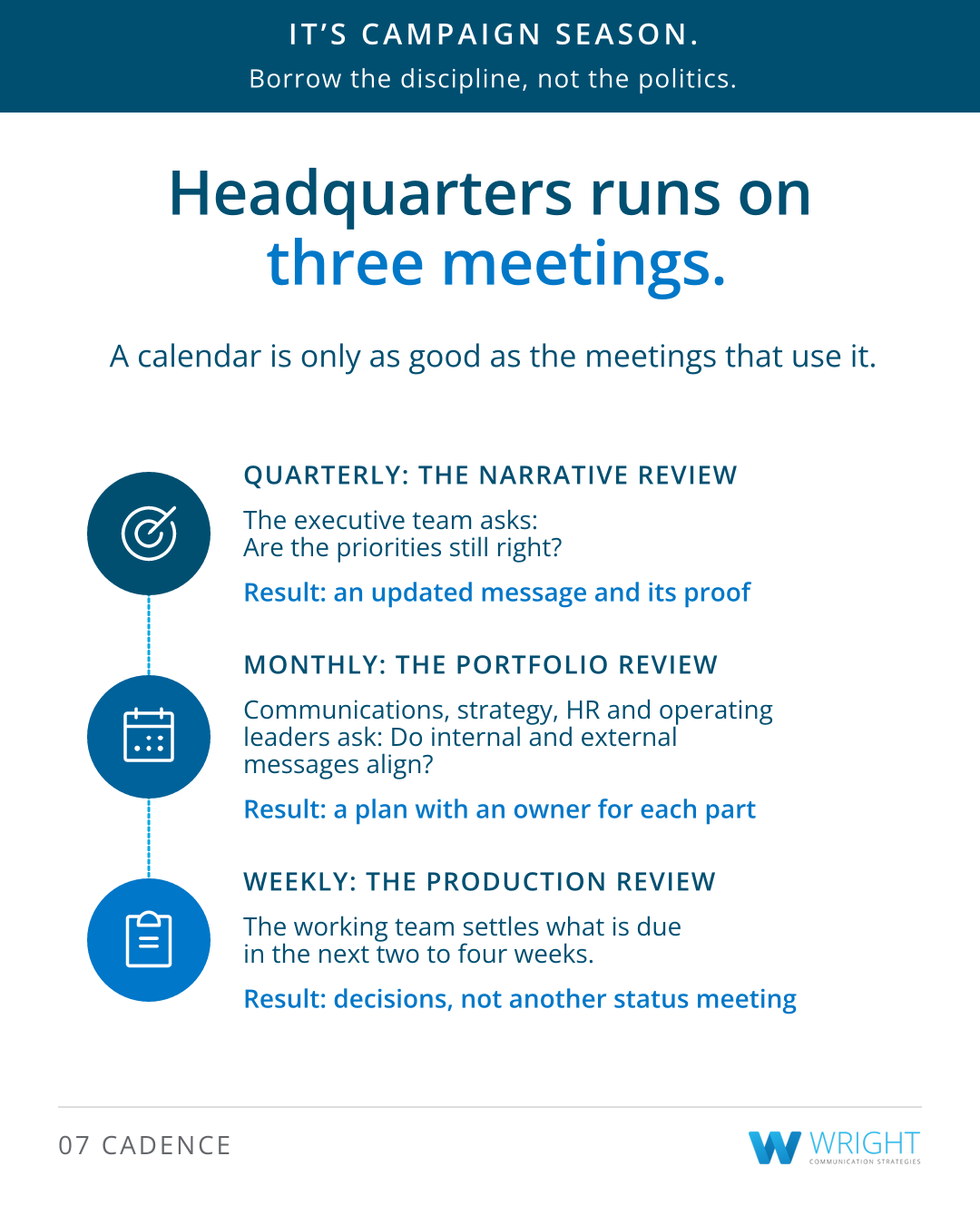
A calendar is only as good as the meetings that use it. Run three.
Quarterly: the narrative review. The executive team looks at the message, not the pieces. Are the priorities still right? Which claims now have evidence, and which have been contradicted? Which decisions demonstrate the strategy? What are employees, customers and investors asking? Which executive leads each part? The output is an updated message and proof ledger, not a rigid publishing plan.
Monthly: the portfolio review. Communications, strategy, HR, investor relations and operating leaders look across the next few months. Which priority is missing, and which is crowded? Are two executives planning big announcements for the same week? Do internal and external messages align, and is sensitive news sequenced correctly? Is too much coming from the CEO? The output is a sequenced plan with an owner for each part of the message.
Weekly: the production review. The working team settles what is due in the next two to four weeks: briefs, evidence, owners, approvals, reuse across channels, and follow-up still owed. The output is a list of decisions, not another status meeting.
Two checks sit around every piece. Before it goes out, someone verifies the facts, disclosure status, audience and links. After it goes out, someone captures the questions, the reactions and the commitments made and feeds them into the next weekly review.
Leave room. A fully booked calendar creates false certainty. Build in open capacity and provisional dates, and name the person who can pause. The PR agency’s guide puts it plainly: “Add a stop owner who can pause scheduled work.”
One story, inside and out
The wall between internal and external communication is thin. Employees read the CEO’s posts and interviews. Customers and reporters can see employee messages when they are forwarded and reposted. Investors compare what leaders say in public with the results.
Practitioners still see employees as their own audience. A study published by the Institute for Public Relations, based on a survey of communication executives and interviews with practitioners, found that nearly every respondent saw an absolute need to treat internal stakeholders as a distinct audience.
That leads to two rules. One enterprise story: the company does not tell employees, customers and investors fundamentally different things. And each audience still gets its own treatment: employees need the implications, the context and a chance to ask questions, not a copy of the press release. If the public voice conflicts with what employees live every day, coordination raises the reputational risk instead of lowering it. Review both audiences in one portfolio. The words can differ; the facts cannot.
An older case shows the machinery. Coca-Cola Enterprises’ rollout, as written up by Cisco’s consulting arm, used a Communications Council, a common vocabulary and a customized roadmap rolled out in phases. It reached knowledge workers through live video, video on demand, intranet audio and a “meeting in a box.” The write-up says a management survey found most respondents very satisfied. Cisco worked on the project, so that finding is its own, not an independent measure. The case does show the design: one story at the center, with coordinated channels around it.
What the evidence shows, and what it does not
Be clear about what a calendar can promise, and what kind of evidence stands behind each claim.
Independent research supports the habits a calendar makes easier: repetition, with the limits the studies report, and substance over visibility.
Listening with follow-up is one of them. A 2026 systematic review of three dozen studies on when employees speak up names “listening with follow-up, invitational openness, feedback, and transparency.” Its authors are careful, too: “The evidence base is dominated by cross-sectional self-report designs, which constrain causal inference.” In plain terms, these habits go hand in hand with employees speaking up. The studies do not prove one causes the other.
Practitioner guidance, like the agency guide and the practitioner’s columns, is experience, not research. Vendor case studies show how a company set up the work, and the figures are the seller’s. Job postings show what employers want, not what works.
None of the research tested a calendar itself. A calendar is infrastructure. It makes timing, consistency, evidence and follow-up more likely, and those habits go hand in hand with trust and understanding. A schedule by itself does not create trust, alignment or reputation. Present it that way, and the case for it is stronger, not weaker.
Where it fails, and the fix for each
Any system built to carry a message can end up serving itself instead. Here are the common ways a calendar fails, and how to fix each.
It becomes a publishing quota. The team starts counting whether the CEO posted twice this week instead of whether people understand the strategy. Empty slots create pressure to publish things that add nothing. The fix: nothing goes on the calendar without a priority, an audience, a proof point and an intended effect.
Volume buries the message. More messages are not more discipline. Ragan, reporting on Gallagher’s research among communications and HR professionals, wrote that most respondents called information overload a growing issue for employees, and said that high-volume internal communication raises the risk of employee burnout and of eroding trust in leadership. A 2024 survey of employees in German companies, none of them executives, published in the International Journal of Strategic Communication, found that the quality of communication from executives and from peers “strongly supports empowerment, while the quantity of executive communication can hinder” parts of it. The fix: review the whole portfolio monthly, and cut the pieces that serve no priority.
The CEO is the only voice. Visibility is mistaken for leadership. The fix: give each message to the most credible voice, the one closest to the evidence.
The message is consistent; the behavior is not. Leaders talk about speed while keeping six layers of approval. The fix: use the quarterly review to name the decisions and incentives that contradict the message. Communication cannot fix an operating contradiction, but it can bring it into view.
Managers get scripts, not understanding. Talking points arrive the morning of the meeting. The fix: brief managers early, with the reasoning and what is still undecided.
It is all outbound. The calendar schedules town halls, posts and newsletters, but not listening, answering and following up on commitments. That can undermine trust and cost the company its best ideas. As MIT Sloan Management Review put it, “employees whose ideas about strategy aren’t listened to may quit — and take their ideas with them.” Two newer trials point the same way, though they tested a channel for speaking up, not ideas about strategy. In U.S. fulfillment centers, giving workers a formal voice channel cut the rate at which they left by about a fifth, according to a 2026 research summary from Cornell’s ILR School. In a trial published in The Economic Journal, turnover was about a tenth lower among workers given an anonymous way to reach HR by phone. The fix: track questions and promises in the same record as outgoing messages, give each an owner, and report back.
Approvals eat the message. Reviewers edit one after another until the piece is late and lifeless. The fix: sort pieces by risk, and give one owner the final decision.
Ghostwriting erases the leader. Polished pieces the executive would never naturally say weaken authenticity, make live follow-up risky, and can turn a leader’s personal account into an undisclosed company channel. The fix: build each piece from the executive’s own views and words.
The tool arrives before the decisions. The fix: settle the narrative, the owners and who decides what first, then pick the tool.
The record is not kept. Approvals happen in email and drafts live in documents, so people start keeping their own trackers. The fix: every change, approval and result goes back into the one record.
Measure at three levels
Reach, open rates and posting cadence tell you the message went out. They do not tell you it landed. If they become the scorecard, the calendar starts serving the scorecard. Measure at three levels instead.
Is the calendar working? On-time delivery, approval time, collisions, the share of items tied to a priority, open commitments, and executive time per piece.
Is the message landing? Comprehension of the choices, recall of the priorities, how ready managers are to explain them, the questions people ask, and whether those questions get answered.
Is the strategy taking hold? Confidence in the direction, trust in leadership, readiness for change, whether employees speak up, and whether decisions and budgets line up with the priorities.
Keep the claims honest. The first two levels show whether the process works and whether people are responding. The third can move for many reasons: results, pay, managers, layoffs, the market. A rise in trust after a year of disciplined communication does not by itself prove the calendar caused it.
The most useful test is also the simplest: can your leaders and employees describe the priorities, explain the choices and point to current evidence?
The first 90 days
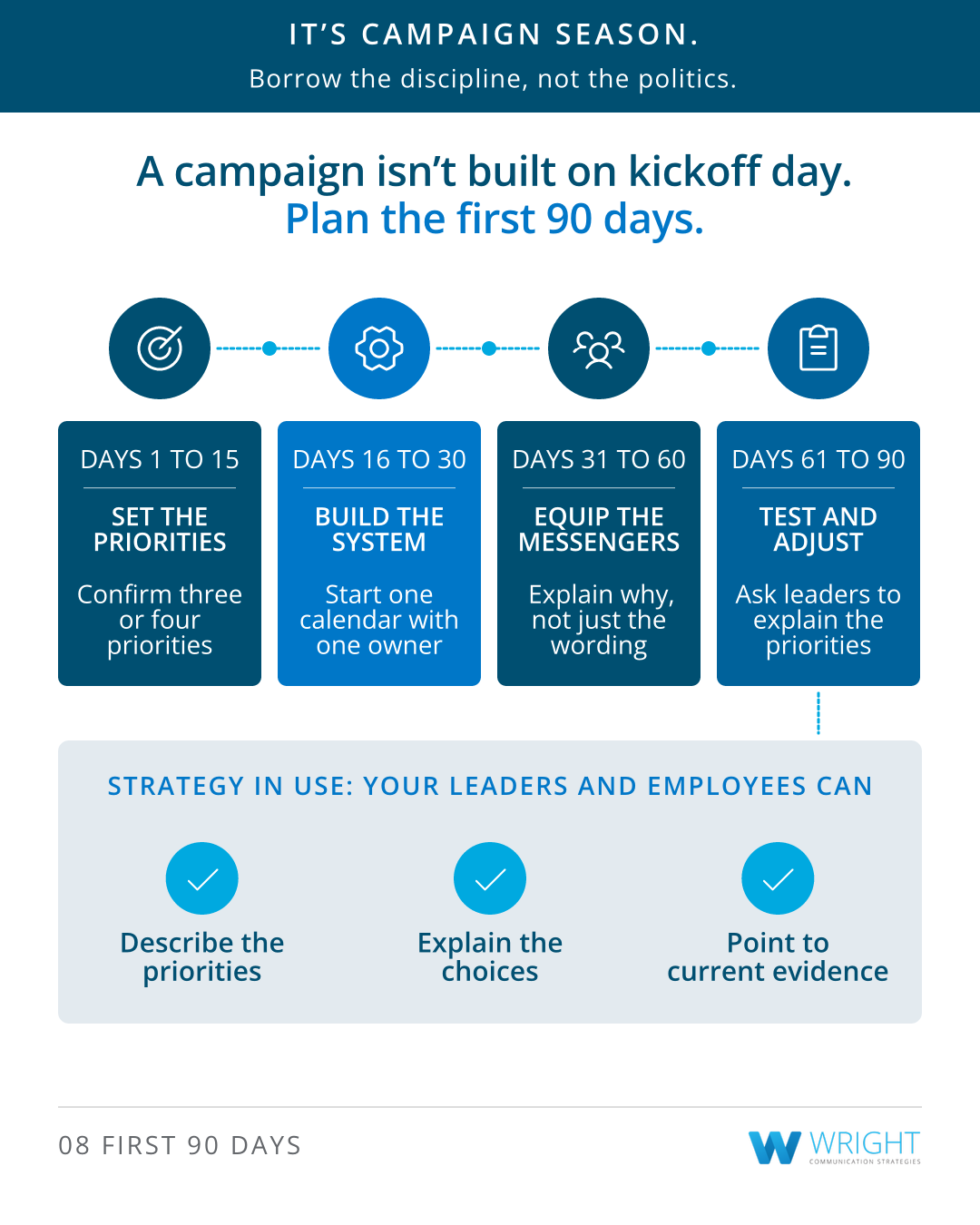
A company does not need a new platform or a large team to start. Here is a plan a CEO and communications lead can run in a quarter.
Days 1 to 15: set the priorities. Confirm three or four priorities. Write one plain paragraph for each, with the choice and trade-off behind it, and the evidence that would show progress. List the hardest questions employees, customers and investors will ask. Map the next 90 days of executive appearances, results and launches.
Days 16 to 30: build the system. Start one calendar record with the fields above, and a proof-point ledger with a status on every entry. Agree who speaks on what, the order of internal and external disclosure, and what each kind of piece needs for review. Name the calendar owner, the final approver and the person who can pause.
Days 31 to 60: equip the messengers. Brief the leadership team on the reasons, not just the wording. Give managers context, examples, likely questions and a path to escalate. Start the weekly and monthly reviews. Carry one strong proof point through several channels. Start logging employee questions and leadership commitments.
Days 61 to 90: test and adjust. Ask leaders and managers to explain the priorities, and listen for differences. Find the topics that produce confusion and the gaps between what the company says and does. Cut the pieces that exist only to fill the calendar. Report back on the questions people raised. Hold the first quarterly narrative review, and update the message and the proof without casually changing the strategy.
The test is whether people can explain the choices and use them in their work.
What CEOs should take from campaign season
The useful lesson is not that CEOs should become candidates.
Strategy adoption has more in common with a campaign than with an announcement.
A strategy must be made memorable. Credible people must translate it. It must be connected to current events and everyday decisions. It must be supported by accumulating evidence. It must answer questions and address contrary facts. And it must continue long after the launch event.
The executive editorial calendar makes that discipline visible and manageable.
It gives the CEO and leadership team a way to see whether they are:
Repeating the priorities or constantly renaming them
Producing evidence or merely producing content
Coordinating leaders or creating competing narratives
Translating the strategy or distributing corporate language
Listening and responding or simply broadcasting
Connecting communication to decisions or treating it as promotion
Campaigns ask people to believe a promise about the future.
CEOs ask employees, customers and investors to do something different: commit time, effort, money and reputation to a strategy whose results will emerge gradually.
No single town hall, memo or polished presentation will earn that commitment.
You earn it through a sustained pattern of explanation, evidence, candor and response.
Repeat the strategy. Refresh the proof. Equip the messengers. Listen to employees. Show what happens next.
That is how a strategy stops being an announcement and starts becoming the way the company operates.
TAKE THE DIAGNOSTIC
Would your leaders describe the same priorities, in their own words? Find out with the One Voice Diagnostic at wrightcomms.com/one-voice-diagnostic.