
Turning strategy into execution the board can measure.
Your value-creation plan needs to reach every level of the organization.
You know what the company needs to do. The challenge is getting the entire organization to understand the plan, recognize its role in delivering it and act on its priorities.
WCS helps investor-backed CEOs align their leadership teams, managers and employees around the strategy, so the plan moves beyond the boardroom and into day-to-day decisions.
INSIDE AND OUT
One narrative for your team. One experience for your customers.

You know what needs to happen. Does the organization?
You have a value-creation plan, the board understands the priorities and your leadership team has been briefed.
But communicating the plan to the executive team is not the same as getting the entire organization to act on it.
Ask three managers what matters most this quarter. You may get three different answers.
One department is focused on cost reduction. Another is prioritizing growth. A third is waiting for decisions that haven't been made.
Each may believe it is following the strategy. But the organization isn't necessarily moving in the same direction.
The consequences become visible:
Priorities compete. Departments make decisions based on different interpretations of the value-creation plan.
Execution slows. Managers and employees spend time resolving confusion instead of advancing agreed initiatives.
Employees become uncertain. They hear about strategic changes without understanding what those changes mean for their responsibilities.
Customer experiences become inconsistent. What the company promises during a transition may not match what different parts of the business deliver.
The CEO becomes the point of escalation. Decisions and explanations that should be handled throughout the organization repeatedly come back to you.
These problems can undermine progress against the plan, even when the strategy itself is sound.
The plan may be clear in the boardroom. The question is whether the organization understands it well enough to deliver it.
A new CEO has a limited window to establish direction.
For a newly installed CEO, the first months matter.
You are establishing credibility, setting expectations, communicating priorities and asking people to move in a new direction. Your words carry weight, but the organization is also watching what happens after you say them.
People need to understand:
What the company is trying to accomplish.
Why these priorities matter now.
What will change and what will stay the same.
What leaders and managers are expected to do differently.
How progress will be recognized and measured.
A town hall or announcement can introduce the strategy. It cannot ensure that the strategy is understood, reinforced and reflected in decisions throughout the organization.
The work is making sure the message travels, the right people can carry it and the organization sees the connection between what leadership says and what the business does.

A practical guide for newly installed CEOs on the first 180 days.
Senior communications leadership to connect strategy with organizational execution.
WCS works directly with investor-backed CEOs to make sure the strategy reaches the people responsible for delivering it.
That means:
Establishing a clear narrative around the value-creation plan.
Aligning the leadership team around the messages that matter.
Translating strategic priorities into language managers and employees understand.
Helping managers carry the message throughout the organization.
Connecting leadership intent with day-to-day decisions and behavior.
Ensuring communication reaches people through channels they actually use.
Establishing ways to assess whether the message is understood and taking hold.
The objective is to make sure people understand what the plan requires of them and can act accordingly, which takes more than communicating the plan more often.
One clear message. Translated for every level.
A strategy cannot be carried throughout an organization by repeating the same presentation or sending the same email to everyone.
Different people need to understand different implications of the same direction.
The board needs to understand progress against the plan. Leaders need to align around priorities. Managers need to translate those priorities into practical direction for their teams. Employees need to understand what the strategy means for their work.
WCS brings experienced, senior-level communications judgment directly to that challenge.
WCS provides the senior leadership needed to connect the company's direction with how it is understood throughout the organization, whether your company has a communications team or relies on people across different functions.
You work with Brian Wright, the person providing the leadership and doing the work.
There are no account-manager handoffs, and no content factory or generic template stands in for his judgment.
From the boardroom to the break room.
The value-creation plan moves beyond the executive team and becomes a direction people understand and act on throughout the organization.
Leaders and managers reinforce the same priorities.
Departments understand what matters most and make decisions consistent with the plan, rather than working from conflicting interpretations.
Employees understand their part in delivering the strategy.
They know what is changing, what is expected of them and how their work contributes to the company's priorities.
The business advances without avoidable communication breakdowns slowing execution.
Integration milestones, operational changes and strategic initiatives are less likely to be disrupted by unclear direction or inconsistent messages.
Customers experience a company whose commitments remain consistent through change.
What leadership communicates is reflected in the information, service and experience customers receive.
The CEO can demonstrate organizational progress to the board and investors.
The conversation moves beyond what has been announced to evidence that people understand the direction, managers are reinforcing priorities and the organization is taking action.
These are meaningful signs that the value-creation plan is moving from strategic intent toward organizational execution.
INSIDE AND OUT
One narrative for your team. One experience for your customers.
When the message lands, the results can be measured.
In one WCS engagement, the organization moved from mixed messages and disconnected experiences toward one clear story carried from management to the frontline.
The reported results included:
264% lift in employee satisfaction
78% lift in customer satisfaction
These figures come from a specific engagement, not a promised result for every client.

Experienced communications leadership. Directly from Brian Wright.
Brian Wright brings more than 30 years of experience getting leaders' messages to land.
His experience includes Anheuser-Busch, Diageo, Wrigley, Mars, Southeastern Grocers and Web.com. He has spent about a dozen years as a senior communications chief working directly with CEOs, including newly installed and long-tenured leaders.
WCS gives investor-backed CEOs direct access to that experience and judgment during periods when strategic clarity, organizational alignment and consistent execution matter.
You work with Brian. The person you meet is the person doing the work.
Find where the message is breaking.
Before deciding what needs to change, it helps to understand where the organization is aligned and where the message is getting lost.
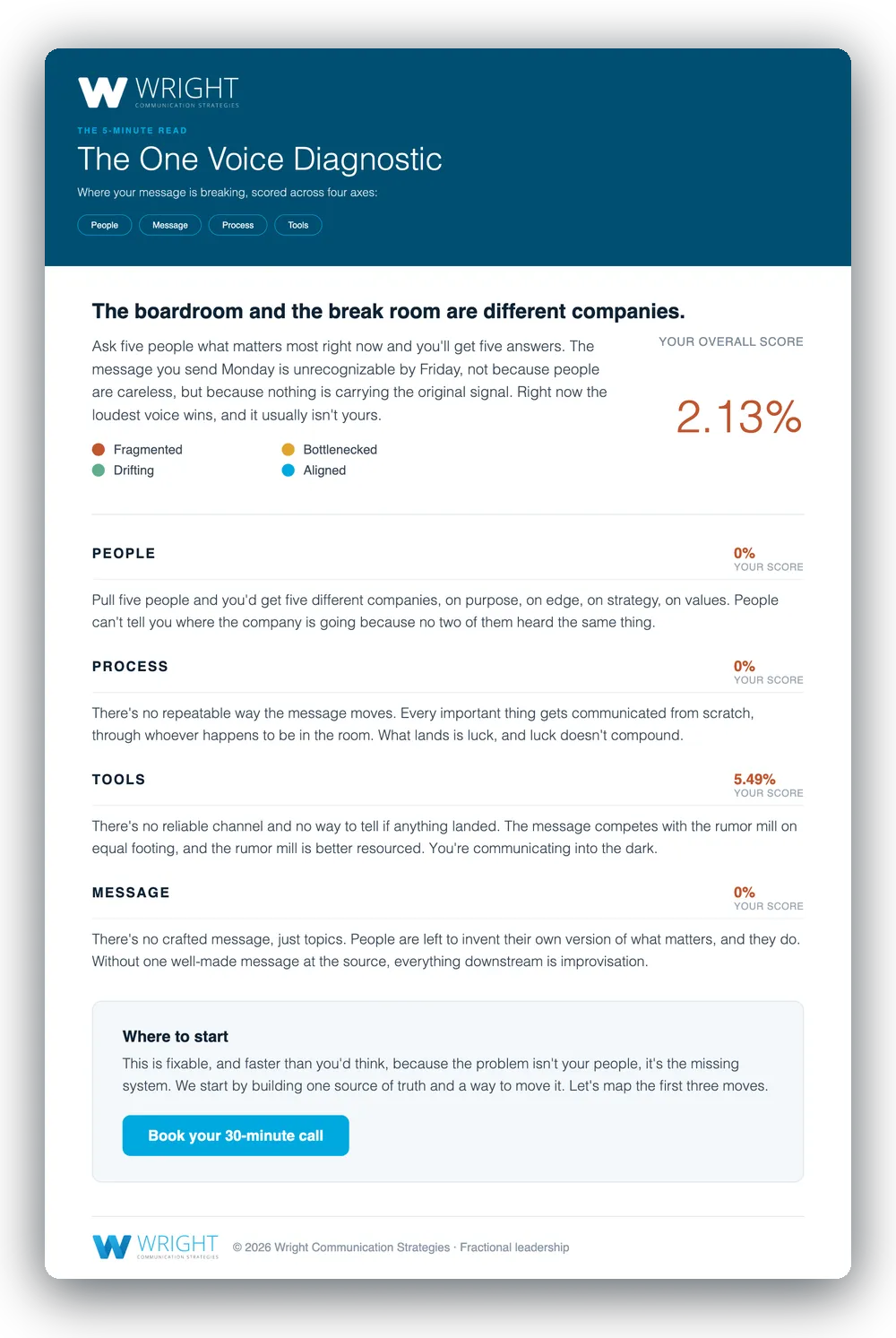
One Voice Diagnostic
A five-minute diagnostic to help identify where communication and alignment may be breaking down across your organization.
Your value-creation plan has to work throughout the organization.
The board knows the plan. Your leadership team knows the priorities.
But if managers are interpreting those priorities differently, employees are uncertain about what they need to do or execution is being slowed by confusion, the plan may not be reaching the people responsible for delivering it.
Let's talk about where organizational understanding may be breaking down and what communications leadership is needed to address it.
More from WCS


© 2026 Wright Communication Strategies, LLC. All rights reserved.